Forecast Details for Mosinee, WI

Recent Locations: Manchester, KY   Hardwick, MN   Mosinee, WI  
Tonight: A 50 percent chance of showers, mainly before 10pm. Mostly cloudy, with a low around 31. Northwest wind around 10 mph, with gusts as high as 20 mph. New precipitation amounts of less than a tenth of an inch possible.
Monday: A 20 percent chance of snow showers after noon. Mostly cloudy, with a high near 37. Northwest wind 11 to 16 mph, with gusts as high as 28 mph.
Monday Night: Mostly clear, with a low around 16. North northwest wind 9 to 14 mph becoming light north after midnight. Winds could gust as high as 23 mph.
Tuesday: Sunny, with a high near 39. Calm wind becoming south 5 to 7 mph in the afternoon.
Tuesday Night: Snow likely before 4am, then snow likely, possibly mixed with freezing rain. Mostly cloudy, with a low around 27. South southeast wind 6 to 11 mph, with gusts as high as 20 mph. Chance of precipitation is 70%.
Wednesday: Rain likely, possibly mixed with snow and freezing rain before 7am, then rain likely, possibly mixed with snow between 7am and 1pm, then rain likely after 1pm. Mostly cloudy, with a high near 56. Chance of precipitation is 70%.
Wednesday Night: Rain, mainly before 1am. Low around 39. Chance of precipitation is 80%.
Thursday: A 20 percent chance of rain after 1pm. Mostly sunny, with a high near 53.
Thursday Night: A slight chance of rain before 1am, then a slight chance of rain and snow. Partly cloudy, with a low around 30. Chance of precipitation is 20%.
Friday: A slight chance of rain and snow before 1pm, then a slight chance of rain. Sunny, with a high near 53. Chance of precipitation is 20%.
Friday Night: A 30 percent chance of rain. Partly cloudy, with a low around 33.
Saturday: A 30 percent chance of rain. Mostly sunny, with a high near 55.
Saturday Night: Rain likely. Mostly cloudy, with a low around 42. Chance of precipitation is 60%.
Sunday: Rain likely. Mostly cloudy, with a high near 63. Chance of precipitation is 70%.

Want more detail? Get the Complete 7 Day and Night Detailed Forecast!

Want to Receive our Free Daily Forecast Emails in your inbox by 5 a.m.?
There are no ads! Learn More
We respect your privacy and will not share or sell your email with anyone.

Current U.S. National Radar--Current

The Current National Weather Radar is shown below with a UTC Time (subtract 5 hours from UTC to get Eastern Time).

Current U.S. National Radar

National Weather Forecast--Current

The Current National Weather Forecast and National Weather Map are shown below.

Today's National Weather Map

National Weather Forecast for Tomorrow

Tomorrow National Weather Forecast and Tomorrow National Weather Map are show below.

Tomorrows National Weather Map

North America Water Vapor (Moisture)

This map shows recent moisture content over North America. Bright and colored areas show high moisture (ie, clouds); brown indicates very little moisture present; black indicates no moisture.

North American Water Vapor Map

Weather Topic: What is Condensation?

Home - Education - Precipitation - Condensation

Condensation Next Topic: Contrails

Condensation is the process which creates clouds, and therefore it is a crucial process in the water cycle. Condensation is the change of matter from a state of gas into a state of liquid, and it happens because water molecules release heat into the atmosphere and become organized into a more closely packed structure, what we might see as water droplets.

Water is always present in the air around us as a vapor, but it's too small for us to see. When water undergoes the process of condensation it becomes organized into visible water droplets. You've probably seen condensation happen before on the surface of a cold drink!

Next Topic: Contrails

Weather Topic: What are Cumulonimbus Clouds?

Home - Education - Cloud Types - Cumulonimbus Clouds
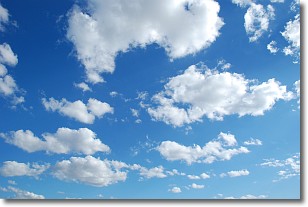
Cumulonimbus Clouds Next Topic: Cumulus Clouds

The final form taken by a growing cumulus cloud is the cumulonimbus cloud, which is very tall and dense. The tower of a cumulonimbus cloud can soar 23 km into the atmosphere, although most commonly they stop growing at an altitude of 6 km.

Even small cumulonimbus clouds appear very large in comparison to other cloud types. They can signal the approach of stormy weather, such as thunderstorms or blizzards.

Next Topic: Cumulus Clouds

Current conditions powered by WeatherAPI.com